Jesús Hernández
Between river and sea, with 460 years of history, St. Augustine stands as the oldest city in the United States and one of the country’s most captivating. St. George Street and its intricate alleyways are a must-see to experience the architecture and vibrant life of this place, as the sun is to Florida.
We arrived in St. Augustine eager to learn about Florida’s history, where years before the arrival of the English pilgrims on the Mayflower, the expedition of Spanish explorer Ponce de León arrived in search of the Fountain of Youth in 1513.
Here we find a park that revolves around the hypothesis of the Fountain of Youth, where a small spring symbolizes what the Spanish were searching for, and native remains recall the Timucua tribe.
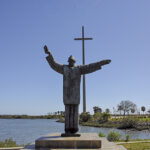
Dating back to 1565 is the Nombre de Dios Mission, a large park overlooking the sea where Pedro Menéndez de Avilés landed and Father Francisco López de Mendoza Grajales celebrated the first Thanksgiving Mass.
Let´s mention the National Shrine of Our Lady of La Leche, a Marian apparition popular among the Spanish settlers in the area.
The original chapel was destroyed in 1728 by British invaders and rebuilt in 1875 and later in 1914.
Harassed by English and French corsairs and pirates, the city of St. Augustine, through a twist of history, fell into British hands in 1763, when the Treaty of Paris awarded Florida to the United Kingdom of Great Britain and Ireland in exchange for the Spanish recovery of Havana in Cuba, which had been invaded by the English.
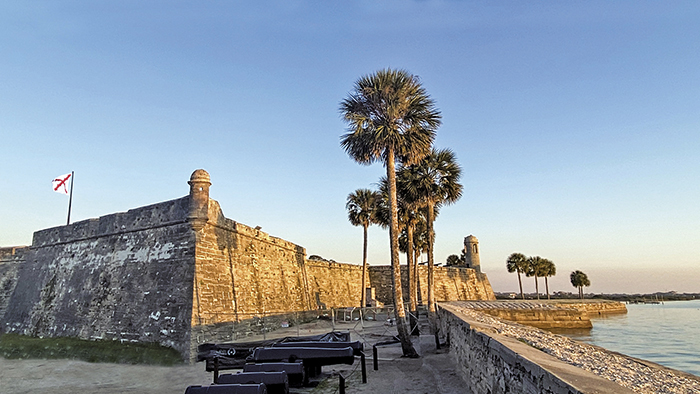
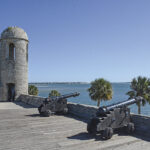
Today, St. Augustine proudly displays its Spanish heritage. Proof of this is the permanence of the fortified Castillo de San Marco and the old flag of Castile with the Cross of Burgundy is still flying by order of the National Parks Administration.
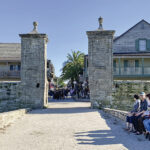
The starting point is the main entrance to the old city, where two columns and part of the retaining wall built by the Spanish in front of the Castillo de San Marco military fort still stand.
An old wooden school, houses from that period, and renovated buildings reveal the splendor this place once enjoyed 400 years ago.
From gift shops, restaurants, terraces, bars, and country and folk music to live rock, you’ll find plenty to enjoy here.
When it comes to gastronomy, this city is known for its home-style cooking. In St. Augustine you can find tasty food like chicken-fried steak, seafood, barbecue, and a lot of vegetables, but also international and sophisticated cuisine with outstanding service.
We arrive at Constitution Plaza, where the slender Cathedral Basilica of St. Augustine stands tall and a large park still houses the pergola where musicians and orchestras delighted the ears of everybody.
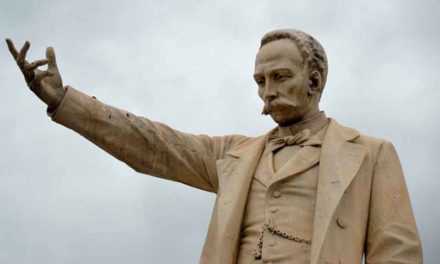
In the gardens of the cathedral basilica, a monument to Father Feliz Varela commemorates the fact that the Cuban religious figure and thinker lived here for part of his childhood and then his final months in 1853. His remains were transferred to Cuba in 1912.
A few more steps and we arrive at the majestic Hotel Ponce de León, which today houses Flagler College.
This beautiful building, with spacious halls and reception rooms, reflects the Spanish Renaissance Neo-Colonial style and was funded by millionaire Henry M. Flagler in 1888, the same man who brought the railroad to Miami and the Florida Keys in 1896.
Another of Flagler’s great buildings in St. Augustine is the Memorial Presbyterian Church, built in 1889, which features an impressive copper dome and elements of Spanish, Italian, Moorish, and Neo-Baroque Revival architecture.
San Agustín, historia y regocijo
Jesús Hernández
Entre río y mar, con 460 años de historia, San Agustín se alza como la ciudad más antigua de Estados Unidos y una de las atractivas del país. Hay que recorrer la calle St. George y sus intrincadas callejuelas para conocer la arquitectura y la pujante vida de este lugar tan floridano como su sol.
A San Agustín llegamos con las ansias de conocer la historia de la Florida, donde antes de la llegada de los peregrinos ingleses del Mayflower la expedición del explorador español Ponce de León llegó a este lugar en busca de la Fuente de la Juventud en 1513.
Aquí encontramos un parque que gira en torno a la hipótesis de la fuente de la juventud, donde un pequeño manantial simboliza el que buscaban los españoles y restos de nativos recuerdan a la tribu de los timucuas.
Del año 1565 es Misión de Nombre de Dios, un amplio parque que mira al mar donde Pedro Menéndez de Avilés desembarcó y el padre Francisco López de Mendoza Grajales celebró la primera Misa de Acción de Gracias.
Destaca el Santuario Nacional de Nuestra Señora de La Leche, una aparición mariana popular entre los colonos españoles de la zona.
La capilla original fue destruida en 1728 por invasores británicos y reconstruida en 1875 y más tarde en 1914.
Acosada por corsarios y piratas ingleses y franceses, la ciudad de San Agustín, por ironías de la historia, pasó a manos británicas en 1763, cuando el Tratado de París otorgó la Florida al Reino Unido de Gran Bretaña e Irlanda a cambio de que los españoles recuperaran La Habana, que había sido invadida por los ingleses.
Hoy San Agustín luce con orgullo su legado español. Y prueba de ello es la permanencia del fuerte Castillo de San Marco, donde por orden de la administración de parques nacionales ondea la antigua bandera de Castilla de la cruz de Borgoña.
El punto de partida es la entrada principal de la antigua ciudad, donde aún prevalecen las dos columnas y parte del muro de contención que construyeron los españoles frente al fuerte militar Castillo de San Marco.
Una vieja escuela de madera, casonas de la época y edificaciones remozadas anuncian el esplendor que tuvo este lugar 400 y tantos años atrás.
Desde tiendas de regalos, restaurantes, terrazas, bares y música country y folk hasta rock en directo, aquí encontrará mucho para recrearse.
Si de gastronomía hablamos, esta zona del país es conocida por la comida casera, y en San Agustín puede encontrar mucho de eso: filete de pollo frito, mariscos, barbecue y verduras, pero también cocina internacional y sofisticada con alta atención.
Llegamos a Plaza de la Constitución, donde luce esbelta la Catedral Basílica de San Agustín y un amplio parque guarda aún la pérgola donde músicos y orquestan deleitaban los oídos de los agustinenses.
En los jardines de la catedral basílica, un monumento al padre Feliz Varela recuerda que el religioso y pensador cubano vivió aquí parte de su niñez y luego sus últimos meses de vida en 1853. Sus restos fueron trasladados a Cuba en 1912.
Unos pasos más y llegamos al majestuoso Hotel Ponce de León, que hoy alberga el Flagler College.
Esta hermosa edificación, que cuenta con amplios salones y estancias, recoge el estilo neocolonial renacimiento español y fue costeada por el millonario Henry M. Flagler en 1888, el mismo que llevó el tren a Miami y los Cayos de Florida en 1896.
Otra de las grandes construcciones de Flagler en San Agustín es la Memorial Presbyterian Church, edificada en 1889, que cuenta con una impresionante cúpula de cobre y elementos de arquitectura renacimiento española, italiana, morisca y neobarroco.