
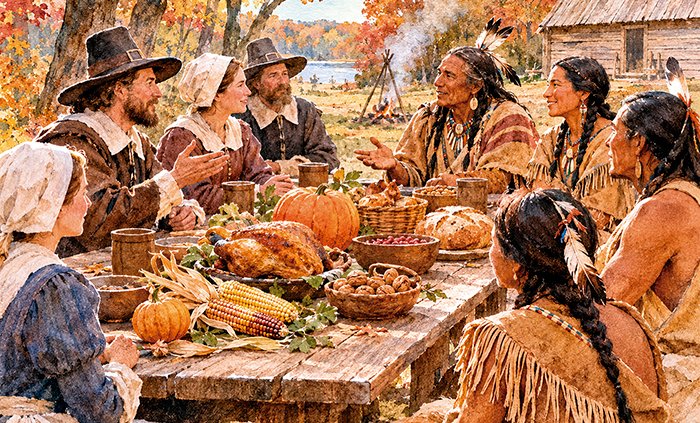
Cada cuarto jueves de noviembre, millones de familias estadounidenses detienen su ritmo para sentarse juntas a agradecer, comer y recordar lo que importa.
WASHINGTON. Hay fechas que se celebran con fuegos artificiales y otras que se celebran con una mesa larga, un pavo dorado y la casa llena de voces. El Día de Acción de Gracias pertenece a las segundas. Cada cuarto jueves de noviembre, Estados Unidos entra en una pausa colectiva: se cancelan las agendas, se llenan los aeropuertos y las carreteras, y millones de personas regresan a la casa de sus padres, abuelos o amigos para compartir una cena que muchos consideran la más importante del año.
Un origen entre la memoria y el debate
La tradición suele remontarse a 1621, cuando los colonos de Plymouth, en lo que hoy es Massachusetts, compartieron una cosecha con miembros del pueblo wampanoag tras un primer año de enormes dificultades. Aquel banquete de varios días, según los relatos históricos, reunió a decenas de colonos y a un número similar de wampanoags, y ha quedado como símbolo de cooperación y gratitud.
Los historiadores, sin embargo, invitan a mirar el cuadro completo. Las relaciones entre colonos y pueblos originarios se deterioraron en las décadas siguientes, y para muchos descendientes indígenas esta jornada se vive con sentimientos encontrados. Desde 1970, grupos nativos se reúnen cada año en Plymouth en un Día Nacional de Duelo, para recordar su historia y reclamar que se cuente completa. Hoy, muchas escuelas y comunidades incorporan estas voces al relato.
De costumbre regional a fiesta nacional
Durante casi dos siglos, las celebraciones de acción de gracias fueron cosa de cada colonia o estado, con fechas variables. Fue la escritora Sarah Josepha Hale, autora de la popular canción infantil “Mary Had a Little Lamb” y editora de una influyente revista femenina, quien durante años escribió a presidentes y gobernadores pidiendo una fiesta nacional.
Su insistencia dio fruto en plena Guerra Civil. En 1863, el presidente Abraham Lincoln proclamó un día nacional de acción de gracias, buscando un gesto de unidad para un país fracturado. En 1941, el Congreso fijó oficialmente la fecha en el cuarto jueves de noviembre, y así quedó establecida hasta hoy. Este año, la celebración cae el jueves 26 de noviembre.
La mesa: pavo, relleno y mucho más
Si algo define esta festividad es su menú. El pavo asado ocupa el centro de la mesa, y se calcula que se consumen decenas de millones de ejemplares cada año en torno a la fecha. A su alrededor, un repertorio casi inamovible: relleno de pan (stuffing), puré de papas con salsa de carne (gravy), salsa de arándanos, batatas dulces, judías verdes, panecillos y, para cerrar, el pastel de calabaza, junto con el de nueces pecanas o el de manzana.
Pero la mesa estadounidense también refleja la diversidad del país. En miles de hogares, el pavo comparte espacio con tamales, arroz con gandules, plátanos fritos, kimchi, curry o pasta. Para muchas familias inmigrantes, incorporar un plato de su tierra a la cena es una forma de decir “pertenecemos aquí” sin renunciar a las raíces. Es, quizá, la expresión más sabrosa de ese mosaico cultural.
 Rituales que se repiten cada año
El día tiene su propia coreografía. Por la mañana, millones de personas sintonizan el Desfile de Acción de Gracias de Macy’s en Nueva York, una tradición televisiva desde 1924, con sus globos gigantes, carrozas y bandas musicales. Por la tarde, el fútbol americano toma el relevo: la NFL juega partidos tradicionales ese jueves, y las sobremesas se alargan frente a la pantalla.
Otra costumbre presidencial es el indulto del pavo. Cada año, el presidente perdona simbólicamente a uno o dos ejemplares en una ceremonia en la Casa Blanca, que luego pasan a vivir en una granja. Es un gesto humorístico, pero ya forma parte del calendario político.
Y, antes de comer, muchas familias practican un ritual sencillo: cada comensal dice en voz alta algo por lo que se siente agradecido. Las respuestas van desde la salud y el trabajo hasta, simplemente, “estar todos aquí”.
El día después: del agradecimiento al consumo
Al día siguiente llega el contraste. El Black Friday, el viernes posterior, inaugura la temporada de compras navideñas con descuentos que han llevado a miles de personas a las tiendas desde la madrugada, aunque cada vez más ofertas se trasladan a internet. Le sigue el Cyber Monday, y el martes, el Giving Tuesday, una jornada creada para impulsar las donaciones benéficas, como recordatorio de que el espíritu de gratitud también puede traducirse en solidaridad.
Más que una cena
Más allá de la comida y el espectáculo, el Día de Acción de Gracias conserva un valor singular: no tiene un origen religioso exclusivo ni un carácter partidista, y por eso puede ser abrazado por casi todos. Es una de las pocas ocasiones en que el país entero comparte el mismo plan y la misma intención: reunirse.
En una época de pantallas, distancias y agendas apretadas, esa sencilla idea sigue teniendo fuerza. Este noviembre, como cada año, millones de estadounidenses pondrán la mesa, abrirán la puerta y, antes del primer bocado, harán una pausa para agradecer. Quizá sea esa pausa, más que el pavo, lo que sostiene la tradición.
Thanksgiving Day: The Table That Unites America
Every fourth Thursday of November, millions of American families slow down to sit together, give thanks, share a meal, and remember what matters.
WASHINGTON. Some dates are celebrated with fireworks, and others with a long table, a golden turkey, and a house full of voices. Thanksgiving belongs to the second kind. Every fourth Thursday of November, the United States enters a collective pause: schedules are cleared, airports and highways fill up, and millions of people return to the homes of their parents, grandparents, or friends to share a dinner that many consider the most important of the year.
An Origin Between Memory and Debate
The tradition is usually traced back to 1621, when the Plymouth colonists, in what is now Massachusetts, shared a harvest with members of the Wampanoag people after a first year of enormous hardship. According to historical accounts, that multi-day feast brought together dozens of colonists and a similar number of Wampanoag, and it has endured as a symbol of cooperation and gratitude.
Historians, however, urge us to look at the whole picture. Relations between the colonists and Native peoples deteriorated in the following decades, and for many Indigenous descendants, this holiday is experienced with mixed feelings. Since 1970, Native groups have gathered in Plymouth each year for a National Day of Mourning, to remember their history and demand that it be told in full. Today, many schools and communities are incorporating these voices into the story.
From Regional Custom to National Holiday
For nearly two centuries, thanksgiving celebrations were a local matter, varying by colony or state, with no fixed date. It was writer Sarah Josepha Hale, author of the popular children’s rhyme “Mary Had a Little Lamb” and editor of an influential women’s magazine, who spent years writing to presidents and governors to request a national holiday.
Her persistence paid off in the midst of the Civil War. In 1863, President Abraham Lincoln proclaimed a national day of thanksgiving, seeking a gesture of unity for a fractured country. In 1941, Congress officially set the date as the fourth Thursday of November, and so it has remained to this day. This year, the celebration falls on Thursday, November 26.
The Table: Turkey, Stuffing, and Much More
If anything defines this holiday, it is the menu. Roast turkey takes center stage, with tens of millions of birds consumed each year around the date. Surrounding it is an almost unchanging repertoire: bread stuffing, mashed potatoes with gravy, cranberry sauce, sweet potatoes, green beans, dinner rolls, and, to finish, pumpkin pie, alongside pecan or apple.
But the American table also reflects the country’s diversity. In thousands of homes, the turkey shares space with tamales, rice with pigeon peas, fried plantains, kimchi, curry, or pasta. For many immigrant families, adding a dish from their homeland to the dinner is a way of saying “we belong here” without giving up their roots. It is, perhaps, the tastiest expression of that cultural mosaic.
Rituals Repeated Every Year
The day has its own choreography. In the morning, millions of people tune in to the Macy’s Thanksgiving Day Parade in New York, a television tradition since 1924, with its giant balloons, floats, and marching bands. In the afternoon, football takes over: the NFL plays traditional games that Thursday, and after-dinner conversations stretch on in front of the screen.
Another presidential custom is the turkey pardon. Each year, the president symbolically pardons one or two birds in a White House ceremony, after which they go on to live on a farm. It is a humorous gesture, but it is now part of the political calendar.
And before eating, many families practice a simple ritual: each person at the table says aloud something they are grateful for. The answers range from health and work to simply “being all here together.”
The Day After: From Gratitude to Consumption
The next day brings a contrast. Black Friday, the Friday that follows, kicks off the Christmas shopping season with discounts that have drawn thousands of people to stores from the early morning hours, although more and more deals are moving online. It is followed by Cyber Monday, and on Tuesday, Giving Tuesday, a day created to boost charitable donations, as a reminder that the spirit of gratitude can also be translated into solidarity.
More Than a Dinner
Beyond the food and the spectacle, Thanksgiving retains a unique value: it has no exclusively religious origin and no partisan character, and so it can be embraced by almost everyone. It is one of the few occasions when the entire country shares the same plan and the same intention: to come together.
In an age of screens, distances, and packed schedules, that simple idea still holds power. This November, as every year, millions of Americans will set the table, open the door, and, before the first bite, pause to give thanks. Perhaps it is that pause, more than the turkey, that sustains the tradition.